
Caravan Roof Lifts & Roof Lifters
Electric linear actuator systems for caravan, camper and lifting-roof applications. Standard multi-actuator and synchronous configurations are available in 12V and 24V, depending on the application requirements.
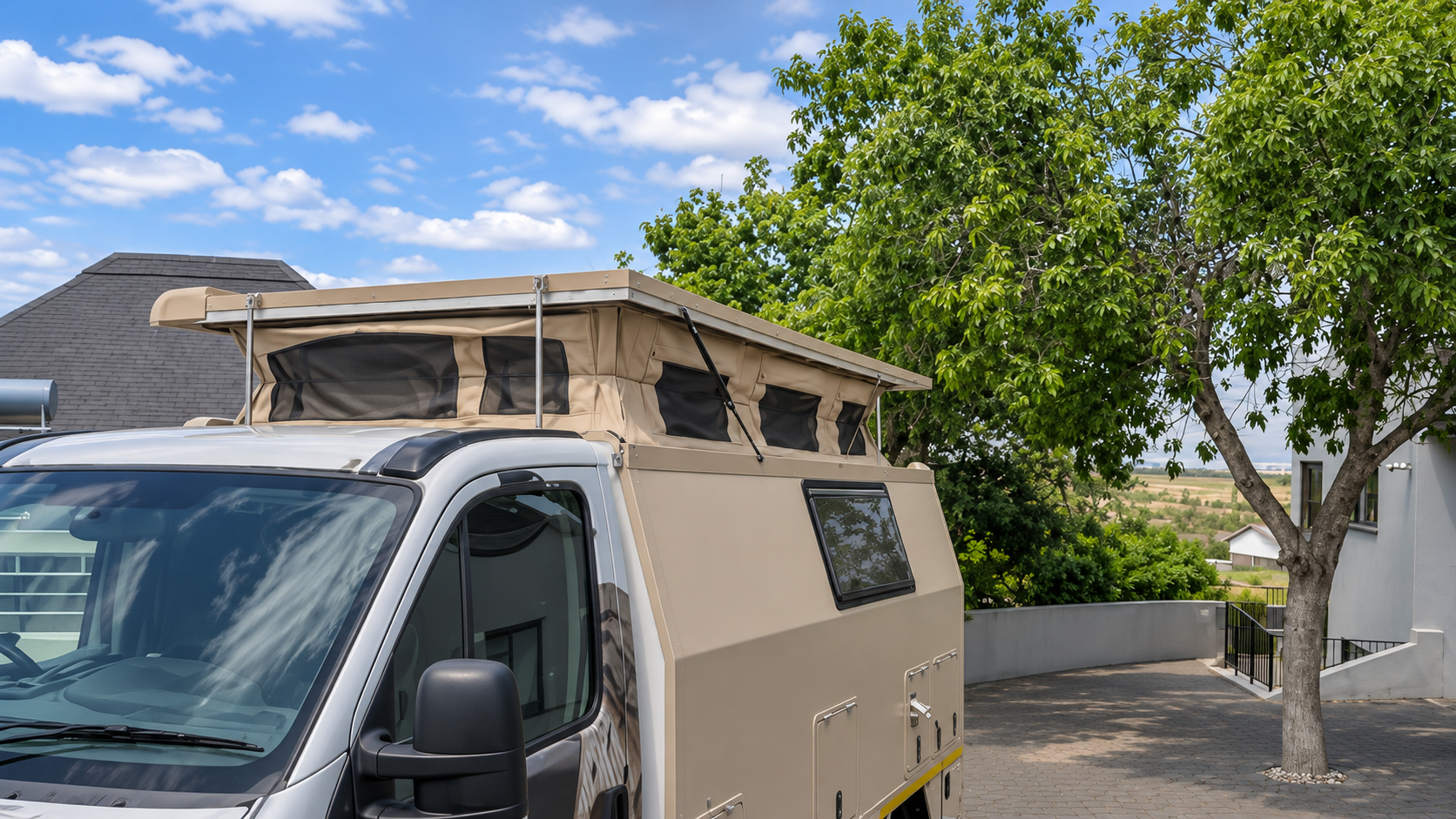
Standard or Synchronous?
Both approaches can work successfully. The choice depends on the roof design, stroke length and how evenly the load is distributed.
Standard Multi-Actuator Systems
Two or four standard actuators can be used where the roof is suitably balanced and independent actuator movement is acceptable.
Standard actuators do not travel at precisely identical speeds. Small speed differences are normal and can become more noticeable over longer strokes.
Synchronous Systems
Synchronous control may be preferred where more coordinated movement between multiple lifting points is required.
- Longer lifting strokes
- Uneven roof loading
- Air-conditioner concentrated on one area
- Solar panels or other unevenly distributed equipment
See Caravan Roof Lifts in Action
Real actuator-based roof lifting applications using different roof and installation layouts.
LINACT-J Roof Lift Systems
A versatile 12V and 24V actuator range for many caravan roof lifting applications.
Standard & Synchronous Configurations
The LINACT-J can be used in standard multi-actuator installations or in synchronous sets where coordinated movement is preferred.
The most suitable configuration depends on the roof load, lifting direction, travel required and overall design of the system.
View LINACT-JAdditional configurations can be supplied for suitable applications requiring enhanced environmental protection or manual emergency operation. Details are provided after the application has been reviewed.
Why the application matters
A caravan roof lift is not selected on roof weight alone. Stroke length, lifting direction, number of lifting points and load distribution all influence the actuator requirement.
Linear Actuators South Africa assists with actuator and control product selection based on the application information supplied.
Information Required for Product Selection
These basic details help us narrow down a suitable actuator and control configuration.
Selected Retrofit Applications
Retrofit projects can often be considered where the required roof and actuator information is known.


When space limits a vertical installation
Existing caravan and camper layouts do not always provide enough space for actuators to operate vertically. In these cases an angled installation may be considered.
Where possible, a straighter lifting arrangement is preferred. With angled installations, the force required at the actuator must account for the mounting geometry.
Because existing roof mechanisms vary significantly, component selection is based on the information supplied by the customer or installer.
Weather Protection & Water Ingress
Roof lifting systems operate in an exposed environment, so the complete installation must be designed with water protection in mind.
Actuator Protection
The actuator IP rating applies to the actuator itself and does not make the complete roof lift installation waterproof.
Different actuator configurations are available for applications with different environmental requirements.
Complete Installation
The installer or manufacturer remains responsible for protecting wiring, connectors, controllers and mounting areas against rain, spray and water accumulation.
Water should not be allowed to collect around seals, electrical connections or control components.
Looking for a Complete Lifting-Frame System?
For OEM and vehicle-manufacturer applications requiring a complete stabilised scissor-frame roof lifting mechanism, view our X-Frame Roof Lift System.
View X-Frame Roof Lift
Frequently Asked Questions
Can you assist with an existing caravan?
Yes. Selected retrofit applications can be considered where the required specifications are known.
Do I need synchronous actuators?
Not necessarily. Standard systems can work successfully where the roof is suitably balanced and the design allows independent actuator movement.
Why can standard actuators move out of sync?
Individual motors naturally have small speed differences. These differences can become more noticeable over longer strokes or where loads differ between lifting points.
Is vertical lifting better than mounting the actuator at an angle?
Vertical or near-direct lifting is preferred where space and design allow. Angled installations can still work, but the required actuator force must account for the mounting geometry.
Are the actuators waterproof?
Different protection levels are available, but the complete installation must also be correctly protected against water ingress.
Do you install caravan roof lift systems?
No. We supply actuator, control and related components together with product-selection support. Integration and installation remain the responsibility of the builder or installer.
Which Measurement Do We Need?
For actuator selection, we require the stroke length only. Please use Measurement A in the image below.

The distance the actuator rod travels from fully retracted to fully extended.
Overall actuator length when fully closed.
Overall actuator length when fully extended.
Do not enter the overall length of the existing gas strut, the closed length, or the fully extended overall length. The actuator stroke is the actual travel distance.
Discuss Your Caravan Roof Lift Application
Complete the known application details below, then send the enquiry directly to us by WhatsApp or email. We can assist with actuator and control product selection based on the information supplied.