
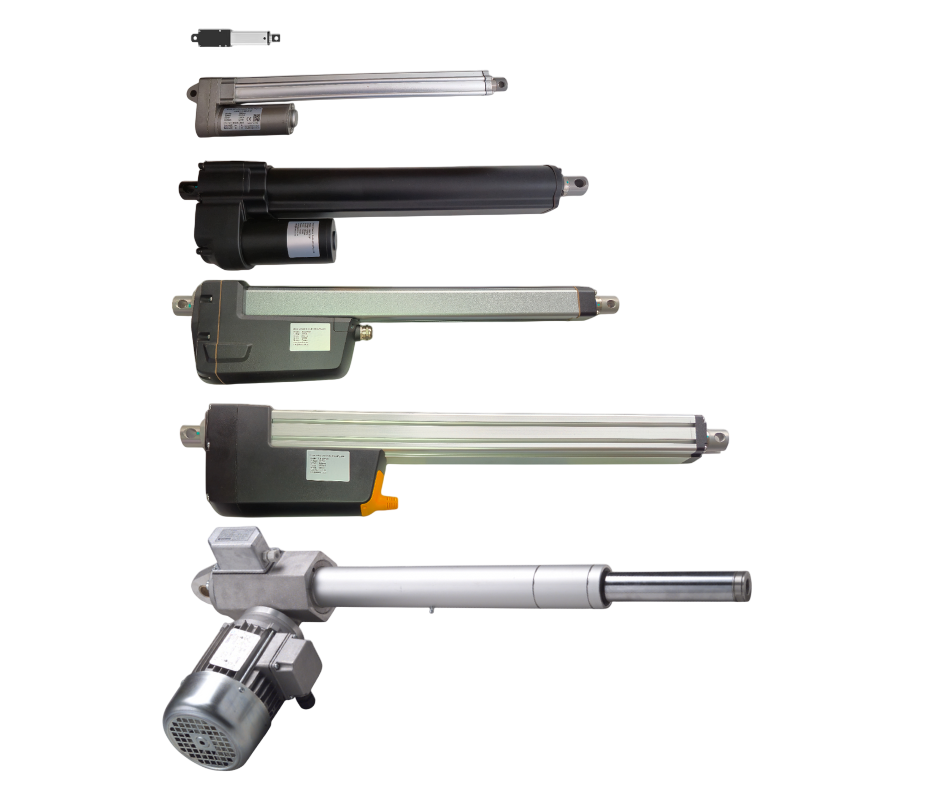
From compact micro-units to massive industrial lifters, we stock a size for every application.
If you are looking to automate a hatch, lift a camper/caravan roof, or move a solar panel, you have likely been told you need a "Linear Actuator." But what exactly is it?
Simply put, a Linear Actuator is a device that converts rotational motion (from an electric motor) into linear motion (pushing and pulling in a straight line). Think of it as an "electric muscle" that can lift, slide, or tilt heavy objects for you.
How to Choose the Right Model
At Linear Actuators South Africa, we supply everything from tiny micro-units to massive industrial lifters. To pick the right one, you need to check these 4 key factors:
1. How heavy is the load? (Force)
This is the most critical factor. Actuators are rated in "Newtons" (N). A rough rule of thumb is 10N = 1kg.
-
Under 200kg?
You likely need our Light Duty Range. These units are compact and perfect for robotics, home automation, throttles, and lifting caravan roofs. -
200kg to 1.7 Tons?
Look at our Robust Range. Ideally suited for solar tracking, lifting heavy hatches, tonneau covers and for heavy machinery hood lifts (e.g. CAT engine hoods). -
Over 1.7 Tons?
You need our Industrial Units. These are the heavyweights designed for mining and industrial machinery.
2. How far does it need to move? (Stroke)
The "Stroke Length" is simply how far the rod extends. If you need to lift a hatch 300mm, you need a 300mm stroke actuator.

- A = Stroke Length: This is the actual distance the rod travels (e.g., 300mm).
- B = Retracted Length: The total length of the unit when it is fully closed.
- C = Extended Length: The total length when fully open (Retracted Length + Stroke Length).
*Ensure you have enough space in your application for the Retracted Length (B) when the unit is closed.
3. What power is available? (Voltage)
- 12V DC: The standard for vehicles, campers, and solar setups.
- 24V DC: Often used in trucks and industrial control panels.
- 230V AC (1-Phase) & 380V AC (3-Phase): For industrial applications where mains power is available.
4. Can it run continuously? (Duty Cycle)
This is the mistake most beginners make. Standard DC motors generate heat when they run. If you run them non-stop, they will overheat.
The Standard "25% Duty Cycle" Rule:
Most of our DC actuators are rated at 25% duty cycle.
This means for every 2 minutes of work, the unit needs 6 minutes of rest to cool down.
If your machine needs to run continuously (like a conveyor belt or production line), standard DC units won't work.
For these applications, we offer the specialized Servomech (Italy) AC Industrial Range. These high-end units are designed for 100% Duty Cycle operation and can work non-stop without overheating.
View our Industrial AC Solutions here.
Choosing the right actuator ensures longevity and safety. If you use a small unit to lift a load that is too heavy, you risk stripping the gears and burning the motor out. Always allow for a safety margin!
Recent Comments